

Reclaiming Girlhood
aka on aesthetics, Uptown Girls, and the commodification of oneself

One day, last month, I found my social media feeds consumed by creators and blogs commenting on the influx of young girls and teens who have been reportedly taking over their local Sephora’s, experimenting with samples and asking about Retinols. And while I understand the desire to have a peaceful shopping experience, both as a consumer and a former cosmetic retail employee— shoutout to all my M.A.C. girlies, and the obvious social critique about the increasing lack of third spaces for youth aside, I wonder if society should be more understanding towards these young teens…
I remember being in high school, wandering around Old Town Pasadena with my friends and spending copious amounts of time in my local Sephora. I wanted so badly to emulate the women I followed on Instagram or YouTube whose makeup was flawless and always had the latest product launches. And as technology and social media continues to expand into all areas of our lives, for today’s youth, many find themselves influenced from all sides— left, right and center; inundated with products and ‘lifestyles’ that appear achievable, just in reach once whatever the latest viral product has been purchased, (think: the Stanley Cup effect). I was 13 wishing I was 16, and 16 wishing I was 18, and 18 wishing I was 21… you get the point. In a way, I feel for these young girls, trying to grow up faster than they should, rushing towards a future whilst forsaking their present (see: Ray Schleine, portrayed by Dakota Fanning in Uptown Girls (2003).
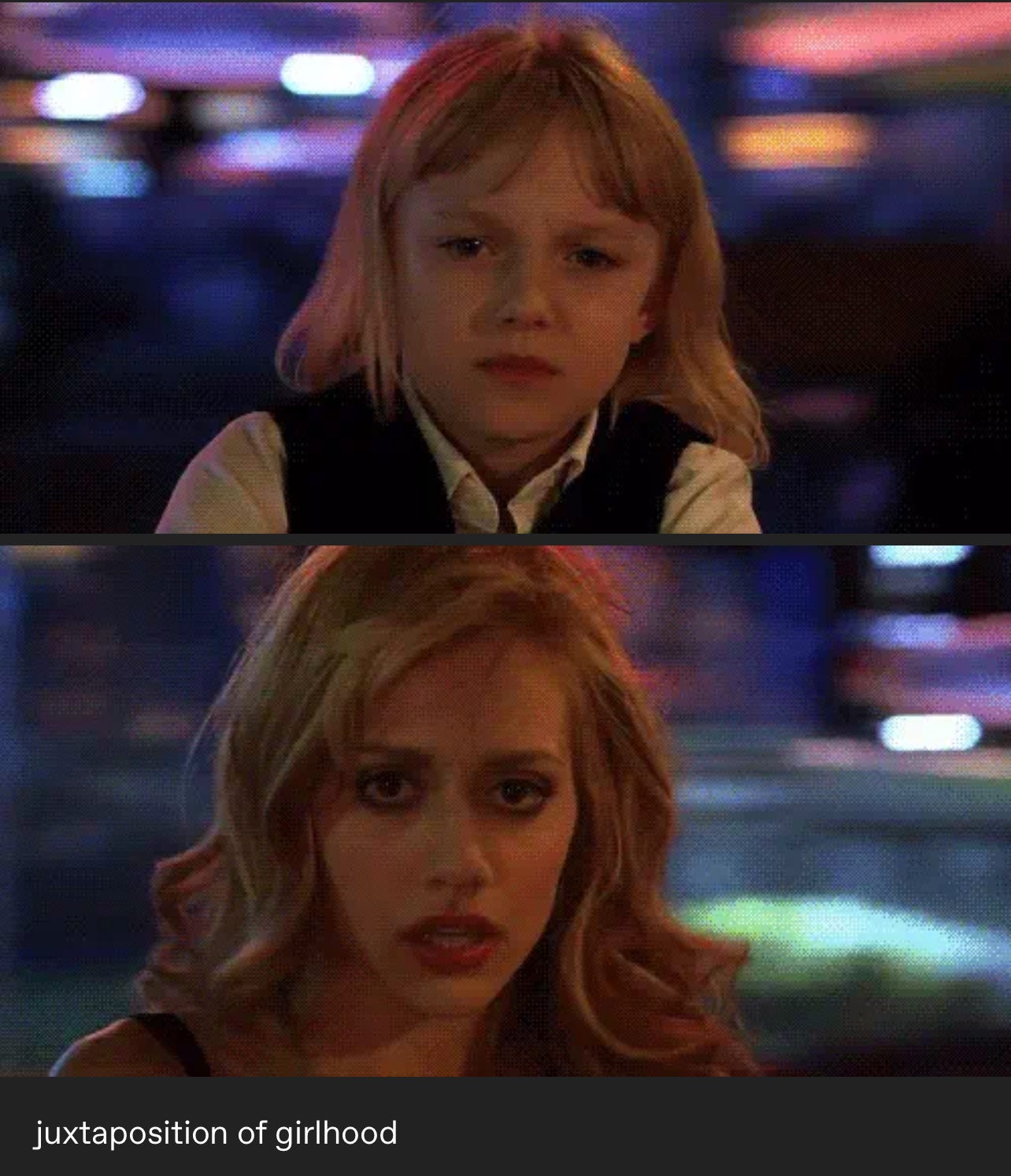
If your tiktok feed looks anything like mine, then every couple of months, you find yourself pelted about by content focused on the latest hyper-niche lifestyle-fashion trend, or subcultures. Last year saw the rise of the clean girl aesthetic, old money style moodboards set to tracks from Lana Del Rey’s Ultraviolence album, and quiet luxury— never mind that “luxury” as a visual signifier is never going to beat you over the head, or come with a million and one think pieces, it is something that is seen and never heard. As my mum always says, money talks, wealth whispers. More recently, it has been the office siren, mob wife, and most notably, coquette-core aesthetic (shoutout to Simone Rocha and the Sandy Liang girlies), a never ending revolving door of plug and play aesthetic personas.
When you type ‘coquette core’ into the search engine of TikTok, you’ll be inundated with videos of aesthetic video compilations featuring an abundance of bows and ribbons, dainty jewelry and more, in varying shades of pink and soft white. And alongside this, are young women sharing how-to guides to embrace this aesthetic. In Laissez-Fare Femininity, Miri of Ephemeras, writes that “coquette… in recent times [has] become a dominant visual modality for gesturing at femininity, sex, power, [and] desire.” And what is intriguing about this increasing desire to embody a specific visual ideal, is that it seems to cast— for however short a period of time, that what it means to be a girl, is monolithic. That while a specific -core trend is the zeitgeist, you should capitalize on fitting yourself into this mold. Because while one could argue that an obsession with pink and jewelry and whatever else is a part of girlhood, the concepts of girlhood and womanhood, like most things exist on a spectrum. There is no right or wrong way to embrace one’s femininity and that it looks different for every individual. And so while the young girls running roughshod in Sephora are being forced to grow up faster than they should, yearning for adulthood, many of us are those girls grown up— now women, seeking ways to connect with their adolescence in ways that were once lost to them.
With the rise of each new aesthetic trend, many criticize this cultural departure from womanhood, questioning why we find ourselves in this moment, myself included. I find myself wary of the need to commodify ones self and the connotation that if I buy enough products, I, too can be whatever the algorithm says I should be. In an article for The Cut, upon noticing the “fervid enthusiasm of grown women to participate in the veneration of girlhood,” Isabel Cristo asks, “what is it, exactly, that’s so uninviting about being an adult woman?” I love this question because it highlights just how diverse the experience of girlhood is and can be. Assuming that every young girl had a childhood where they could freely explore their interests, were nurtured by their guardians in ways separate from basic care needs and held no major responsibility, then the incessant need to girlify everything becomes somewhat suspicious; but when we acknowledge how for many young women, their childhood was not a time in which they were free of burdens and responsibilities, a lightbulb moment happens, and while valid critiques can still be brought up, one may begin to see this heightened interest in girlhood as a reclamation.
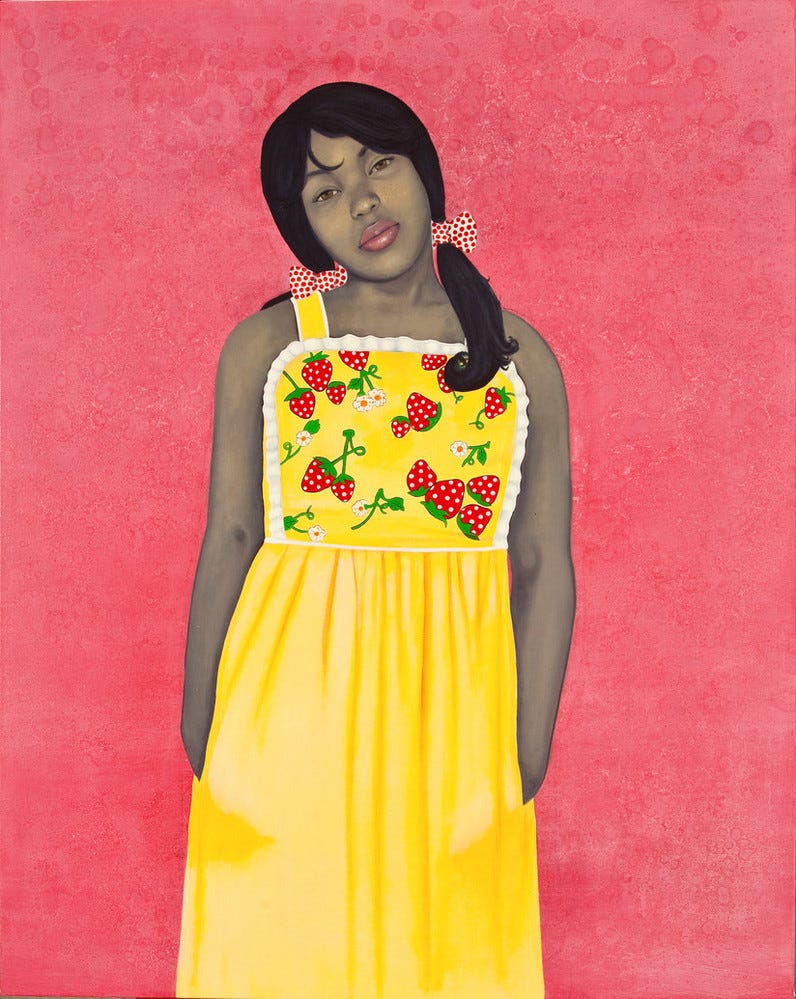
Another way of considering this, is through the lens of fine art. One of my favorite paintings, is a piece by Amy Sherald entitled, They Call Me Redbone but I’d Rather Be Strawberry Shortcake (2009)
The title of the painting refers to the subject, a young Black girl, as a “redbone,” which is a racialized slang term often used to describe Black women of a lighter complexion. And when used colloquially, it often contains an intimate overture. But it’s the second half of the painting’s title that I find most poignant— “I’d Rather Be Strawberry Shortcake,” and how it signifies that the subject, has at some point been forced to relinquish her girlhood and is now searching for a way, or voicing her wish to return to it.
In her article, Miri, says that what is largely driving women to seek out and perform girlhood in their adult lives is because “girlhood, by contrast [to womanhood], is light, universal, joyful. It allows a comforting retreat.” However, I disagree. For many young girls, specifically marginalized girls— in this case, specifically Black women, girlhood and childhood was/is not this euphoric space devoid of responsibilities. Many were/are forced to grow up faster than necessary due to circumstances outside of their control. And as a result, this return to girlhood is likely an attempt to honor their inner child and make peace with the version of themselves who wasn’t given the opportunity to cultivate hobbies or dress how they wanted, etc. And when we acknowledge this, we can then acknowledge that the working definition of girlhood that we are interrogating and exploring— one that is “exuberant and hyperfeminine, playful and innocent— [is] therefore, almost always white.” That’s not to say that all iterations of performed girlhood or a return to it, is devoid of value; however, interrogations should be made, one must always remain acutely aware of the myriad of ways in which girlhood exists, and understand that one woman’s experience is never the same as the woman standing next to her.

And as girlish trends continue to emerge and circulate in and out of today’s virility cycle— balletcore, the office siren, mob wife, etc., etc. and I move further into womanhood, I find myself more introspective and considering whether or not girlhood ever really ends?
And how do we, as women, reconcile all the disparate parts of ourselves as we get older? Who we once were, who we hoped to be, who we’ve become and what we’ve lost as a result of it all. As I address these inquiries, I find myself extending grace to those exploring themselves and their identity through these “archetypes,” myself included. To quote Miri once more, “… it may be useful to also think of girlhood in its own right as a meaningful time and space, as a place for liberation and advocacy and identity formation. We are not adults when we are children, but we are ourselves. We are human and capable of feeling, capable of decision making, capable of resisting indoctrination and distinguishing right from wrong.” And when the world is telling you who and how you should be, look, think and act, it is a radical form of self-acceptance to truly discover and assert who you are in this world. And like all good things, that takes time.
As always, if this generated any interesting thoughts or questions, please drop them in the comments, I’d love to hear from you :)
xx gabi
—
Sources:
https://www.thecut.com/article/girl-culture.html?utm_medium=s1&utm_source=tw&utm_campaign=nym https://www.vanityfair.com/style/2023/07/peak-girl